You are viewing the expanded version of this Marina,
for faster browsing
use the regular version here
 Save to PDF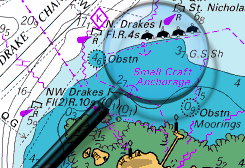
Holy Loch, inc. Marina
Courtesy Flag
Flag, Red EnsignWaypoint
None GivenCharts
Admiralty, 1994, 3746Rules & Regulations
Keep clear of all piers and slips when anchoring.Hazards
Head of Loch Dries Out. Ferry and Tripper Boat TrafficTidal Data Times & Range
+0115 Dover MHWS 3.4m, MHWN 2.9m, MLWN 1.0m, MLWS 0.4m (links)This site is designed for slower, roaming broadband connections, like you would get at sea, so it needs JavaScript enabled to expand the text.
General Description
At around the point where the Firth of Clyde meets the River Clyde proper,....
.... a basin is formed with three lochs branching from it.
The first loch you will encounter on your port side as you head northish past Dunoon is Holy Loch. This relatively small loch was used by the US Navy up till the early 90s as a submarine base. It was also the home to the famous Robertson's boatyard, notable for building the first 15-Metre yacht designed by the legendary William Fife (Shimna, 1907).
Nowadays this well sheltered loch is turned over mainly to pleasure use, with plenty of residents moorings, and room to anchor, although it is not quite as big as it first looks as the north-west corner dries out significantly.
Holy Loch Marina which has seen big developments and improvements in the last year or so, nestles in the lee of White Farlane Point. Full Marina facilities are available here for visiting small craft. Our link above to tides is for Greenock which will be within a couple of minutes of the tides at the Holy Loch Marina.
Holy Loch would be well worth a visit unless the wind is screaming from the East.. from all other directions it is totally sheltered.
Approach
The approaches to Holy Loch are straight forwards enough,.....
..... with deep water fairly close in on the southern side off Hunters Quay. The Northern side has submerged rocks radiating about 200 m from Strone Point. These are marked by a southerly cardinal buoy (No 30) (Q(6)+Lfl.15s). This buoy has been reported as having a weak light.
Keeping in depths greater than the 20 m contour clears all dangers when entering. Once within there are various anchoring and mooring options which are now covered...
Berthing, Mooring & Anchoring
Any kind of anchoring within Holy Loch, involves finding a spot....
..... with shelter from the wind, where the depths are suitable for a small craft. It also involves keeping clear of all the local moorings.
All jetties and quays should be given a suitable offing when anchoring so as not to impede ships using them, likewise when manoeuvring within 300 m of them... keep away from ferries and ships.
Possible anchorages on the south shore of Holy Loch include north of Hunters Quay, clear of the ferry slip, also anywhere between Hunters Quay and White Farlane Point. The shore here dries out up to about 150m off, and is then steep to.
North-west of White Farlane Point, most of the water suitable for anchoring is taken up with moorings (see photo gallery).
Some of these moorings belong to the Holy Loch Sailing Club, which has its premises ashore between the Marina and Ardnadam Pier. Water can be obtained by jerry can from the club. A link to the club's website is provided below:
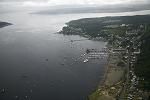
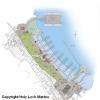
Next up on your port side comes Holy Loch Marina. Significant redevelopment work has been going on here meaning it bears little resemblance to the latest chart we display here... see the marina plan provided.
The Marina works on VHF channel 80, telephone 01369 710800. Contact them to arrange a berth, visitors are catered for.
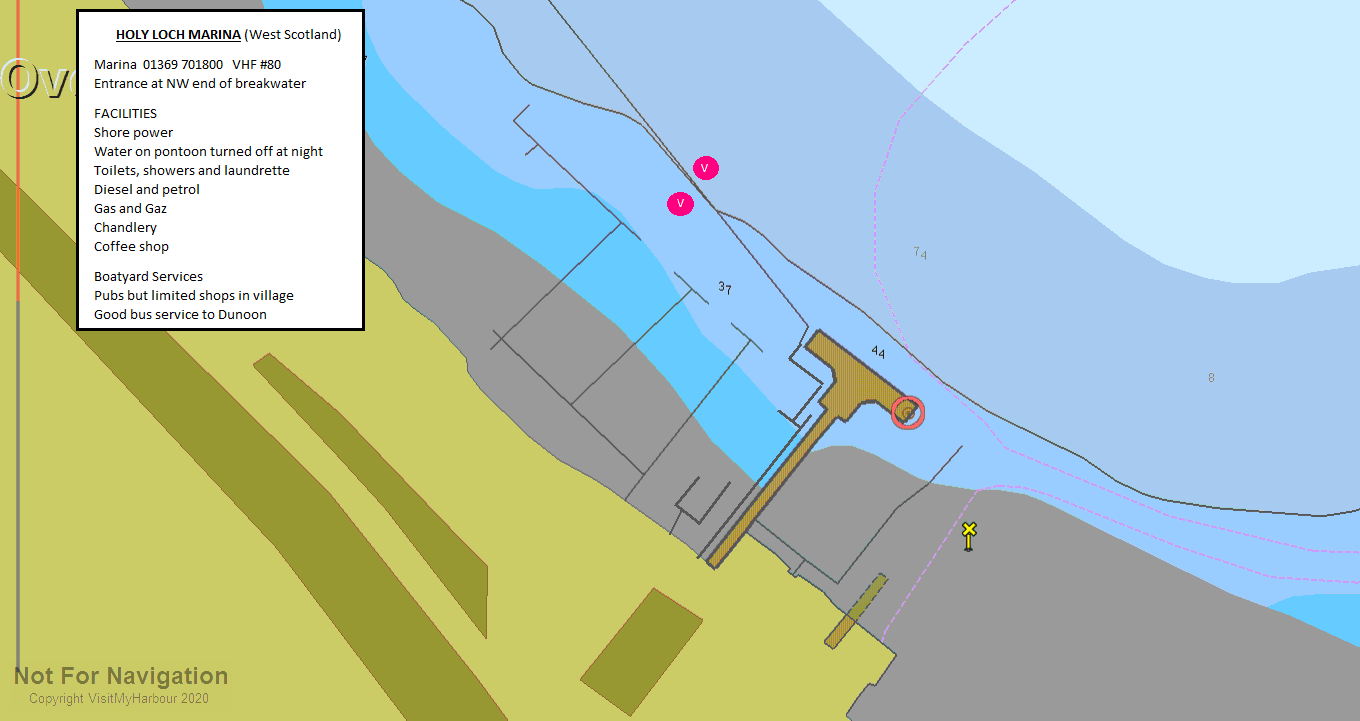
Visitors are normally assigned to the outer breakwater and, obviously, a berth near the Southern end of that breakwater would be preferable (nearer the facilities) but, have a care; the pier at the South end of the development is used to ship timber and lorries will be delivering their loads all through the day and once in a while a cargo ship will come in and clear the pier which takes about a day and a half.
That operation can be noisy for some people (though we found it not too noisy) but the main draw back is on dry days with a southerly breeze which will result in you being affected by dust throughout your stay. The Marina is well aware of this and in their development plan that pier is being moved to the boulder pier to the North of the marina (already in the process of being done - 2016)
Unfortunately, although they have made some progress to that but, as we write in 2019, that's on a "wee bit of a hold for the moment"; this means the logging operation still continues from pier the SE end of the outside pontoon.
Update 2021. One of our members (Richard Jacobs) has reported that they now have a damping down system for "logging days" and that dust is no longer a problem
New for 2017 was the provision of Wifi which we are told is available now (2019) on the pontoons
A link to their website is provided below:
http://www.holylochmarina.co.uk/
Charges here (2022) are £3.20 per metre, which includes electricity and VAT They have a deal for "second night half price for a two day stay" and an attractive weekly rate (£19.50pm). A lunchtime stop (up to four hours) will cost you £6.50.
Local facilities in this area are covered in the next section.
On the northern side of the loch, again there are various anchoring possibilities, and reports of visitors mooring buoys laid to the West of the disused pier just in from Strone Point.
Other possibilities are around Gibb's Point, and to the North West of the stone pier at the village of Kilmun. Water is obtainable at the pier, and again there have been reports of nearby visitors moorings.
Village facilities will be found ashore at Kilmun including shops are post office and a nearby Hotel.
If nosing around the northern shore looking for an anchorage, pay particular attention to the various charted rocks shown, all within the 5 m contour (at CD), and also note the foul area laying to the west of Graham's point.
Facilities
Holy Loch Marina offers full facilities to visiting craft, with dredged depths of 3m below LWS. Power and water are available on the pontoons, toilets and shower and laundry facilities ashore.
Both Calor and Camping gas are available, together with a fuel berth selling diesel and petrol. A coffee shop is on site.
Boats can be lifted and stored ashore here up to 23 tonnes, 60ft max. Marine engineers are based at the Marina, together with an antifouling removal specialist. Clyde Sea Recovery, various charter operators and brokers will be found too.
Trailer sailers are catered for at the Marina, with access at all tidal range and a charge of £18 for launching and recovery.
Ashore at the village will be found shops, post office, grocer/off licence and a Pub/Restaurant just over the road from the Marina.
There is a bus service into Dunoon for major supplies (but, for pipe smokers, we are told that the old fashioned tobacco shop on the High street has closed)
History
The Holy Loch is a sea loch in Argyll and Bute, Scotland. Open to the Firth of Clyde at its eastern end, the loch is approximately one mile wide and between two and three miles (5 km) long, varying with the tide. The town of Dunoon on the Cowal peninsula lies on the shores of the Clyde just to the south of the loch, and houses continue round the villages of Kirn, Hunter's Quay at the point with the landing slip for Western Ferries, Ardnadam and past Lazaretto Point, the village of Sanbank, with open countryside at the end of the loch, then on the northern shore Kilmun, and at Strone Point the village of Strone continues round to the western shore of the Clyde, almost joining Blairmore on Loch Long. The name Holy Loch is believed to date from the 6th century, when Saint Munn landed there after leaving Ireland.
All the villages used to have piers served by Clyde steamers, and now Western Ferries runs between Hunters Quay and McInroy's Point on the outskirts of Gourock, while the Caledonian MacBrayne service runs from Dunoon to Gourock pierhead. At the end of the loch a road runs past the Benmore Botanic Garden and Arboretum (also known as the Younger Botanic Gardens) to scenic Loch Eck and on towards Oban.
During World War II the loch was used by the Royal Navy as a submarine base, served by the depot ship Forth. The loch was used extensively for trials and exercises by Royal Navy submarines during the Second World War, the submarines Vandal and Untamed were lost in the Clyde after being sunk by accidents during exercises. Untamed was later salvaged.
Near the Holy Loch an anti-submarine boom was constructed between Dunoon and the Cloch Point Lighthouse to defend waters from German U-boats.
US Navy
Between 1961 and 1992, Holy Loch was the site of the United States Navy's "FBM Refit Site One". It was the home base of Submarine Squadron 14, part of Submarine Force, U.S. Atlantic Fleet. To make maximum usage of it Submarine-launched ballistic missile deterent force, American military had determined that it required an overseas base for refit and crew turnover. Negotiations with the British Government began as early as March 1959 when President Dwight D. Eisenhower mentioned the need to British Prime Minister Harold Macmillan at a meeting at Camp David.
Holy Loch was one of several locations on or near the Firth of Clyde considered for the refit site. Others were Faslane, the channel between Largs and Cumbrae, Rosneath Bay, and Rothesay Bay. Site selection criteria included the requirements for a sheltered anchorage, relative proximity to an international airport, and sufficient shore facilities to provide housing for military personnel and their families. Agreement for the use of Holy Loch was reached near the end of 1960 and the arrival of the first tender, USS Proteus (AS-19) scheduled for December of that year. Divisions within the British government and concerns about protests by the Campaign for Nuclear Disarmament (CND) caused her arrival to be rescheduled to Friday 3 March 1961.
Between 1961 and 1982, the Naval Support Activity ashore was administered by US Naval Activities London. In 1982, Naval Support Activity, Forward Base, Holy Loch, Scotland became its own command. NAVSUPPACT ultimately managed 42 facilities and leased 342 housing units for Navy personnel and their dependents.
Robertson's Yard
Alexander Robertson started repairing boats in a small workshop at Sandbank in 1876, and Alexander Robertson and Sons Ltd (Yachtbuilders) went on to become one of the foremost wooden boat builders on Scotland's River Clyde.
The 'golden years' of Robertson's yard were in the early 1900s when they started building classic 12 & 15 Metre racing yachts. Robertsons was well known for the quality of its workmanship and was chosen to build the first 15-Metre yacht designed by the legendary William Fife (Shimna, 1907).
More than 55 boats were built by Robertsons in preparation for the First World War and the yard remained busy even during the Great Depression in the 1930s, as many wealthy businessmen developed a real passion for yacht racing on the Clyde. During World War II the yard was devoted to Admiralty work, producing a wide range of large high speed Fairmile Marine Motor Boats (MTB's and MGB's).
After the war the yard built the successful one-class Loch Longs and two David Boyd designed 12-Metre challengers for the America's Cup: Sceptre (1958) and Sovereign (1964). Due to difficult business conditions the Robertson family sold the yard in 1965, and it was turned over to GRP production work (mainly Pipers and Etchells) until it closed in 1980.
During its 104 year history, Robertson's Yard built 500 boats, many of which are still sailing today. The yard ceased trading in the early 1980's and the site was levelled soon after. The site has since been consumed by residential building and the new Holy Loch Marina development.
http://en.wikipedia.org/wiki/Wikipedia:Text_of_the_GNU_Free_Documentation_License
Eating, Drinking & Entertainment
Only the local village facilities already mentioned are in the immediate area of the Marina. The nearby town of Dunoon offers much more choice for the hungry and thirsty crew.
If you are here for the last weekend in August do not miss the Cowal Highland gathering - Balmoral is a side show by comparison. Every Pipe band in Scotland worth its kilts shows up and many from around the world.
There are various pubs/hotels and cuisines ranging from Indian to Italian...
The links below may give you an idea but be careful - some of the listed ones are close as the crow flies - on the other side of the Clyde!!
Pubs:
http://www.beerintheevening.com/pubs/results.shtml/el/Dunoon%3BArgyll/
Links
|

Got a comment to make about Holy Loch ? Have you found this coverage helpful ? HAVE YOUR SAY (your email address will always be kept private)
 Find local marine businesses
Your Ratings & Comments
There are a few restaurants in Dunoon, but I would recommend the Queen Street chippy as it gave an ample portion for £8.
I visited in August 2023, and would re-use the marina when next in the area.
Items can be ordered for delivery from Gael Force (as detailed on the marina website).
View all 12 feedback items
 Weather & Tide Links